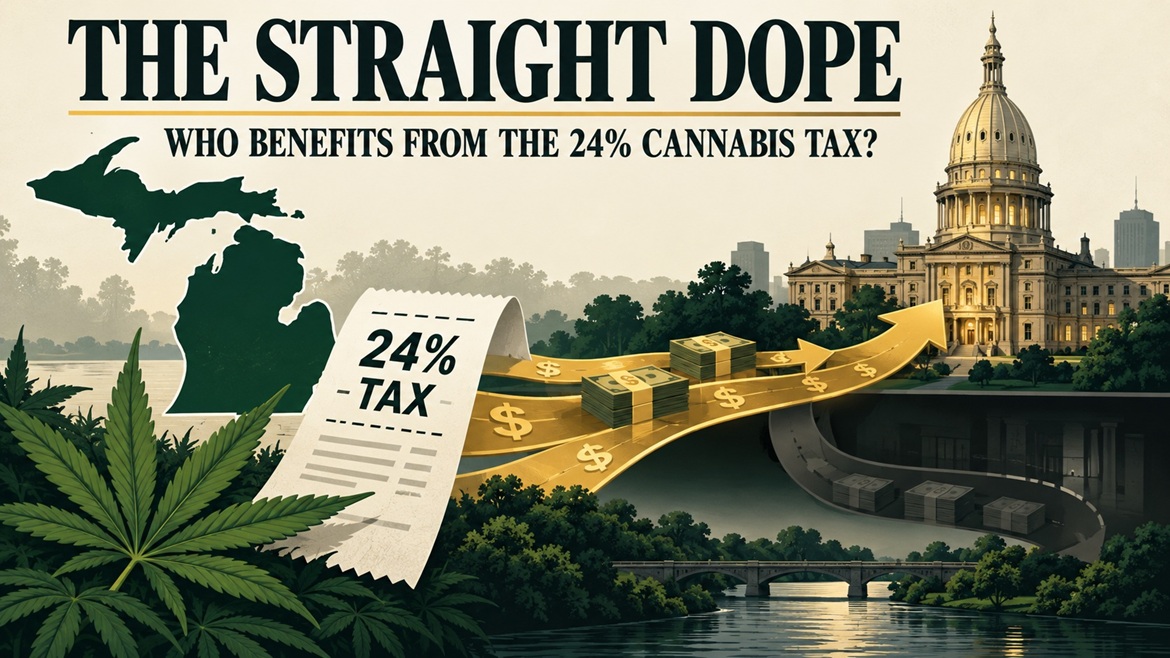
Everyone, particularly small dispensary owners, are enraged about the 24% cannabis tax in which the Republicans, Democrats and special interests pissed in the faces of the cannabis community.
But this was no mere policy failure, this was a diabolical plot to crunch and consolidate the cannabis industry and drive all those who made it flourish to the poor house so the corporate vipers can gang bang what has become Michigan’s top cash crop.
Michigan’s 2025 adult-use sales finished around $3.17 billion, below roughly $3.27 billion in 2024 – the first annual revenue decline in the state’s recreational era. This put the industry into an already precarious position. Cannabis taxes differ from ordinary sales taxes because the untaxed alternative is not only reduced consumption; it can be an illicit purchase. Consumers can pay $0 in taxes like they used to in the good ol’ days, and more of them certainly are choosing to do so in lieu of the tax.
Michigan’s cannabis market entered 2026 with extremely low flower prices and intense competition, forcing business owners into a bind. If a dispensary chose to hold the price to protect traffic, the levy came out of the supply chain’s already-thin gross margin. If it chose to raise price, it risked lower volume, cross-border substitution, or migration to illicit channels. Either path is economically painful.
As a result, the industry suffered and it showed in the tax receipts for the state. Jan-Jul adult-use revenue totaled about $1.755 billion, compared with $1.841 billion in the same period of 2025 – a decline of about $86.2 million, or 4.7%. The original Senate Fiscal Agency modeling estimated about $420.7 million of annual wholesale-tax revenue under its central assumptions. By the state’s May 2026 forecast, the fiscal-year estimate for the new tax was $315 million.
If retailers suppress price increases to preserve traffic, the consumer sees less of the tax but balance sheets absorb more of it. Layoffs, store closures, reduced cultivation, delayed vendor payments, and consolidation are indicators of tax stress before statewide sales plummet, and the dam is about to break.
Michigan’s 24% wholesale tax has materially worsened an industry that was already undergoing a painful shakeout. It has increased the cost of staying legal, forced businesses to choose between margin destruction and price increases, contributed to documented layoffs and closures, and coincided with continued statewide revenue contraction.
Before the 24% wholesale tax, the cannabis industry certainly faced many problems. But it was a buyer’s market. The prices were so low and the supply so abundant that it was unbelievable. Who was the big loser in the pre-tax market? It was not the little guys. We were able to struggle along. It was the big guys who were really getting reamed.
The big corporate weed players were greedy. They did not want a cap on licenses. They overdeveloped and overinvested. They thought the money tree would not stop. But the free market humbled them. They had to compete with small businesses that were more responsive and could provide a better product with diversity of vendors.
As a result, they went to work. They founded the MCMA in an attempt to crush medical caregivers. It was too obvious what they were trying to do, so they had to shift to a roundabout way to consolidate the industry. This is where the cannabis tax came in.
The cannabis tax was an incomprehensible policy sold as a lie with the intent to destroy. Those who passed it knew it would never bring in the revenue that it was supposed to bring in. Both Republicans and Democrats knowingly peddled a lie.
Why would they do such a thing? Because they want another industry in Lansing feeding from the trough. They want a legal cannabis special interest that is constantly pumping money into the system, into campaigns, into the mouths of bozos like the Ozempic-resistant Joe ‘Estrogen’ Aragona.
They want the cannabis industry to operate like Beer & Wine monopoly, one of the most corrupt monopolies in the state. That is why they are crafting legislation that would further harm the smaller operators. They want to take deferred payments off the table. They want to give the crooked and unfair CRA more authority. It’s a deliberate squeezing of the industry.
I want to make it clear that big multi-store dispensaries are behind the 24% cannabis tax. They’re acting like they are against it but they’re really for it because they want to swallow up the industry. They are pulling the wool over our eyes. They can afford to take short-term losses knowing that the monopoly is coming down the line.
It has become clear that infrastructure has been set up within the cannabis space to provide the controlled opposition preventing us from pushing back too hard against the establishment. Instead, lawsuits that will go nowhere are filed and half-measure legislation is pushed—all to pump the breaks on serious backlash that could prevent the industry takeover.
I have dealt with these people, and I can tell you they are not serious. They have all sold out the cannabis industry for 30 shekels. They will not do what it takes to go after the Lansing machine. I am an army of one in this regard. But my takes on the cannabis industry in Michigan have proven prescient in the past, and they will again.
What happens when an industry achieves a monopoly? What happens when there is one or a small handful of powerful interests dictating an industry? Prices go through the roof. Look at what happened with energy in our state, for example. Or health care. This is how Lansing does business. We are among the most corrupt states in the nation and that corruption is seeping through to the cannabis market.
I will continue fighting against this system, exposing it and causing as much reputational damage to the lawmakers responsible as humanly possible. But it is also time to go nuclear against those in the cannabis community who purport to be for the grassroots when they are really the Benedict Arnolds stabbing us all in our backs.